


Hyundai unveils new IONIQ 3
At 4.1m long, it’s not the smallest Hyundai electric car – that honour goes to the Inster supermini. The Ioniq 3’s size means there are a fair amount of fresh rivals for it to contend with.
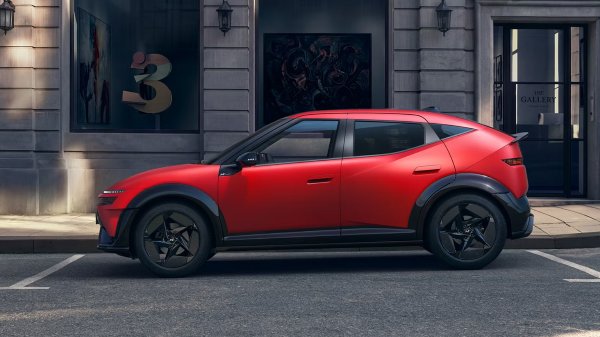
Both the Ioniq 5 and Ioniq 6 have pretty distinctive designs, so it’s no surprise the Ioniq 3 looks set to turn a few heads, too. Hyundai describes the model as an ‘aero hatch’ and while it sits higher than the Concept Three, the overall profile is familiar, with a low front end, swept-back windscreen and tapered windowline.
The overall surfacing of the Ioniq 3 comes from Hyundai’s ‘Art of Steel’ design philosophy, which is most evident in the creases down the side that point up towards the rear spoiler. Colour-contrasting wheelarches help give the Ioniq 3 a squat-looking stance (although not quite as extreme as the show car’s) and to the rear the upright form and narrow light bar have a whiff of the Alfa Romeo SZ.
As with the Alfa, Hyundai’s design is purposefully bold, with one designer telling us “the best thing for us is people not immediately loving it, we want a polarising design”. An element of the Concept Three that hasn’t made its way to the Ioniq 3 is the fake exhaust, which provided exterior sound on the concept. However, we were told that this feature might be something we’ll see on future Ioniq 3 models, such as a hot Ioniq 3 N.
Hyundai Ioniq 3: range and powertrains
Sitting on a shrunken version of the E-GMP architecture (shared with Hyundai’s Ioniq 5, but more closely Kia’s new EV2), there’s a 400-volt system on board. There’s also a choice of a ‘Standard Range’ 42.2kWh battery or a ‘Long Range’ 61kWh unit.
The smaller battery will return more than 208 miles, which is up on the EV2’s 194-mile range, while the Ioniq 3 Long Range is rated in excess of 304 miles, way above the maximum 281 miles in the EV2. Part of the reason behind the efficiency gap is down to aerodynamics, the Hyundai has a drag coefficient of 0.26.
Hyundai hasn’t provided a maximum charging-speed figure for the Ioniq 3 just yet, but it says the standard-range model will take 29 minutes to top up from 10 to 80 per cent of its battery capacity; the long-range car takes a minute longer. The Ioniq 3 supports 11kW charging and there’s the option to have a 22kW charging cable as well.
It’s no surprise that the Hyundai features the same choice of electric motors, too. The Standard Range has a nine-second 0-62mph time with a 144bhp motor, while the Long Range with its 134bhp electric motor takes 9.6 seconds.
The Ioniq 3 might look like the sleeker cousin to the EV2, but it’s got the bigger boot, at 440 litres, once you remove the load-bay floor.
The front features a big space under the centre console which can extend into a large flask storage area by removing one of the cup-holders entirely – a pretty nifty solution.
Trim levels haven’t been announced yet, but certain versions will get the same ‘relaxation seats’ as the ones we enjoyed in the N Line car, plus heated and ventilated seats, a Bose sound system, dual-zone automatic climate control, ambient LED lighting and several interior clips (in a similar vein to Dacia’s YouClip option) for items such as torches or cup-holders. Customers may even be able to make their own 3D attachments in future, according to Hyundai.

Fill in your details below and a member of our team will be in touch

By providing your details you consent to us being able to contact you using the methods given above. Read more.
Fill in your details below and a member of our team will be in touch
By providing your details you consent to us being able to contact you using the methods given above. Read more.
Fill in your details below and a member of our team will be in touch
By providing your details you consent to us being able to contact you using the methods given above. Read more.
Please leave your details and we will call you back as soon as possible to confirm your appointment slot.
Let us know how you would like to receive your virtual appointment in the comments. Eg Zoom, Skype, Whatsapp.
By providing your details you consent to us being able to contact you using the methods given above. Read more.
Fill in your details below and a member of our team will be in touch
By providing your details you consent to us being able to contact you using the methods given above. Read more.